

Human-AI Orchestration & Agentic Language Education at CLE
Human judgment, AI capability, empowered communicators.
Our Vision
At CLE, language education is about developing communicators who can claim their voice and use it with intention, courage and clarity, communicating across languages and cultures in diverse contexts. Grounded in strong expertise in language and communication, we design learning environments where AI strengthens human capability and that voice, and expands opportunities for meaningful, highly rigorous learning.
As the field moves toward agent-based ecosystems and emerging pedagogic agents, we position AI as a dynamic, agentive partner and presence in learning — one that supports more deliberate thinking, increased judgment, and greater ownership of communicative choices. These systems are designed to enhance human insight, not replace it, and to create conditions where learners engage more critically, creatively, and confidently.
At the centre of this vision is human judgment: the contextual, relational decisions learners must grow into as communicators. They learn to read the room, sense the audience, interpret context, and recognise nuance — the subtle cues that define real communication and shape its impact. Through close collaboration with experienced communicators and mentors, students receive nuanced feedback that helps them understand appropriateness, subtlety, and communicative rigor. Learning thrives through relationships that motivate, and through human judgment that determines readiness, depth, and authenticity.
We believe in a future where every student, educator, institution, and community can orchestrate AI with confidence — turning technology into a catalyst for deeper connection, richer understanding, and more empowered communicators.
This is how CLE pushes the boundaries of language and communication education: by amplifying human insight through thoughtful, responsible AI, and preparing learners to navigate, direct, and co-create with emerging agentive systems in an AI-driven era.
Principles of Human–AI Orchestration & Agentic Language Education
Human judgment as central
AI amplifies human judgment, voice, and expression; it never replaces nor overshadows them. Language and communication learning is anchored in the contextual, relational decisions learners grow into as communicators.
Orchestration for everyone
Human–AI Orchestration is embedded across curriculum, pedagogy, assessment, experiential engagement, and scholarship and research so that every learner and every educator can participate confidently and competently in AI-mediated communication environments.
Standards that hold
As AI evolves, our commitment to communicative clarity, rigor, ethical practice, and authentic human capability remains constant. High standards guide both human and AI-supported learning.
AI integrated in learning
AI is integrated deliberately to strengthen judgment, voice, and connection — expanding opportunities for practice, insight, and more intentional communicative choices.
Learners as co-creators
Students collaborate with experienced communicators, mentors, and AI systems to design tools, practices, and innovations. They shape how AI supports language and communication.
Preparing for agentive systems
We explore emerging pedagogic agents and define how they should operate under human judgment, voice, ownership, and ethical boundaries — ensuring learners can navigate and direct agentive systems with confidence.
Shared standards beyond CLE
Principles and practices developed at CLE are shared with universities, schools, and communities, contributing to sector-wide leadership in responsible, human-AI centred communication.
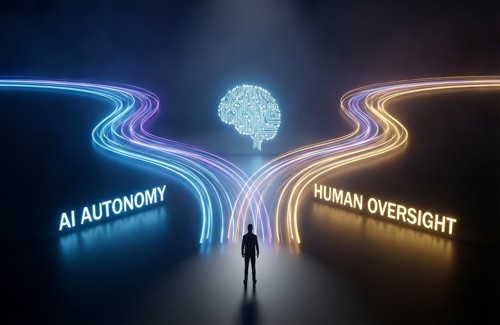
The line this centre exists to hold: AI autonomy on one side, human oversight on the other.
Snapshot of Impact
Impact and Reach
CLE's initiatives in Human–AI Orchestration & Agentic Language Education are already shaping teaching and learning across curriculum and assessment, innovation, student co-creation and experiential engagement, funded projects and grants, scholarship and research, and community and global engagement. Together, these efforts show how Human–AI Orchestration is advancing and redefining language and communication at HKUST and beyond.
Learners Reached
8,774 students reached through a CLE GenAI literacy module, building foundational AI literacy and responsible practice across disciplines.
Curriculum & Assessment Advancements
• 24 courses audited for GenAI-resilient, authentic, and human-centred assessment.
• 62 assessments redesigned to strengthen clarity, rigor, and responsible AI use.
• Numerous explorations of AI use, and scholarship and research, across CLE courses.
Innovation, Student Co-Creation & Experiential Engagement
A growing ecosystem of Human–AI Orchestration is emerging at CLE. Students and mentors have co-developed four AI-supported tools — two for English communication and two for Chinese communication — extending learning beyond the classroom and strengthening communicative capability.
• Utter — an English speaking practice app with level-matched prompts, speech recognition, and immediate feedback.
• Podium — an English simulation platform for interviews, pitches, and presentations, offering personalised insights for high-stakes communication.
• XiYouQuest — a story-led Putonghua practice platform with short, repeatable missions and AI-supported feedback to build PSC readiness.
• Meli — a Chinese-language learning-support platform that surfaces key signals before, during, and after class to help mentors identify needs early and strengthen course design.
CLE has hosted 2 hackathons and will be doing more to involve students and faculty in AI in language and communication.
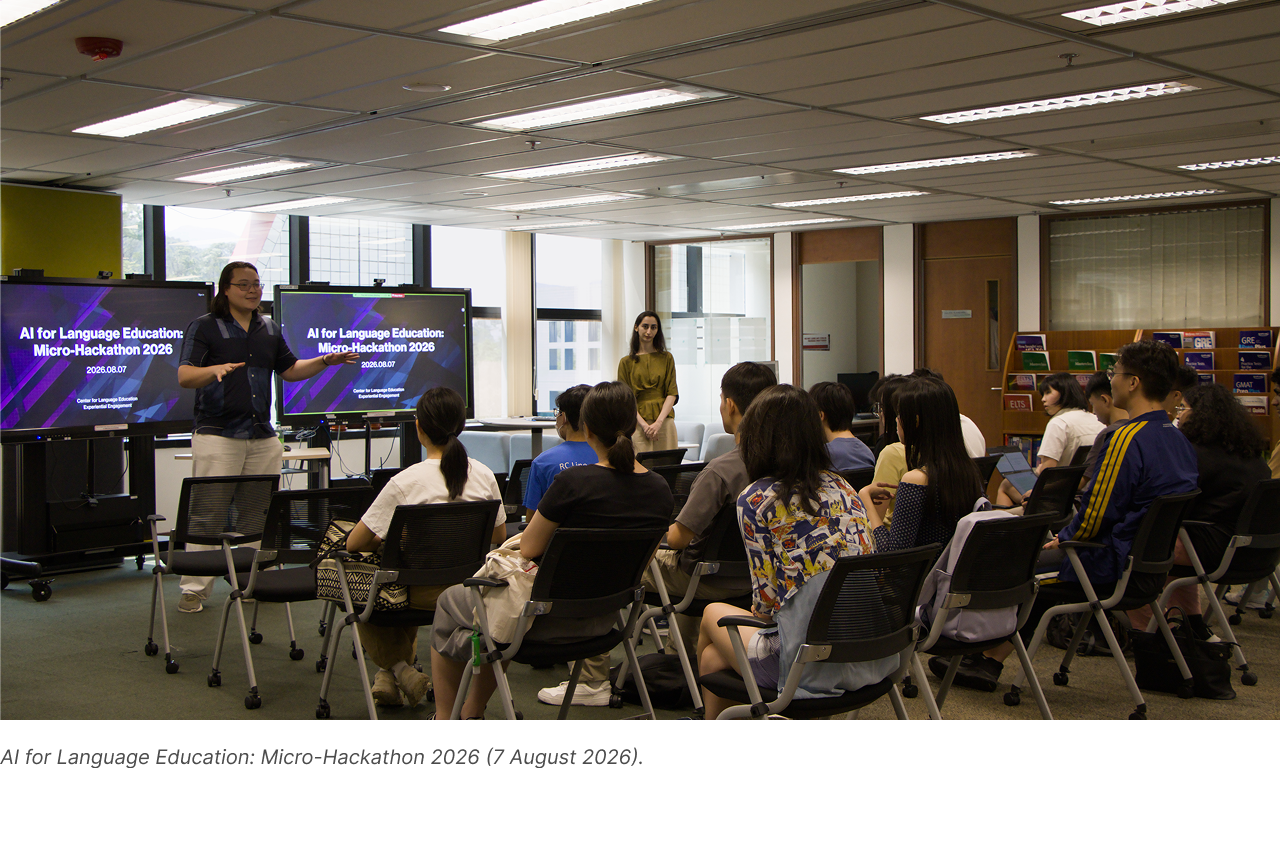
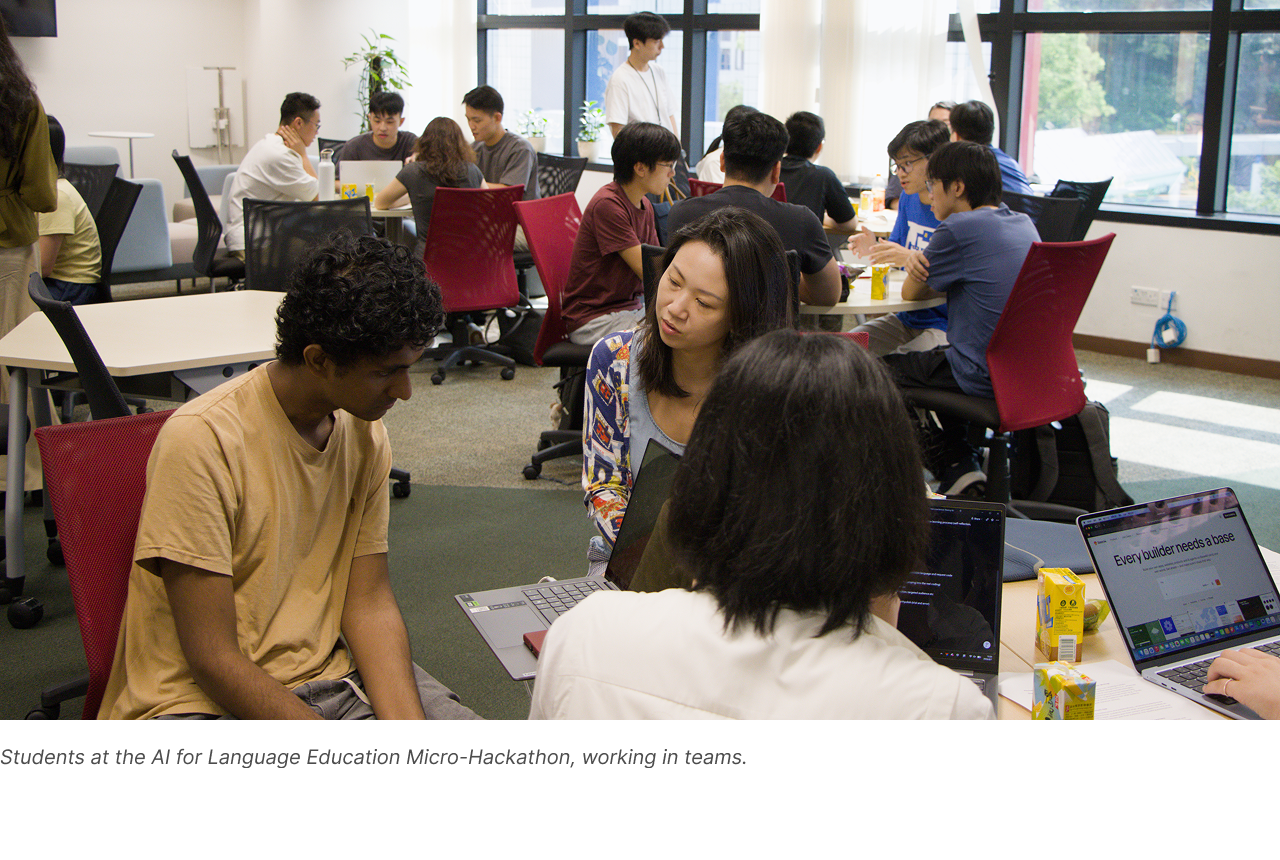
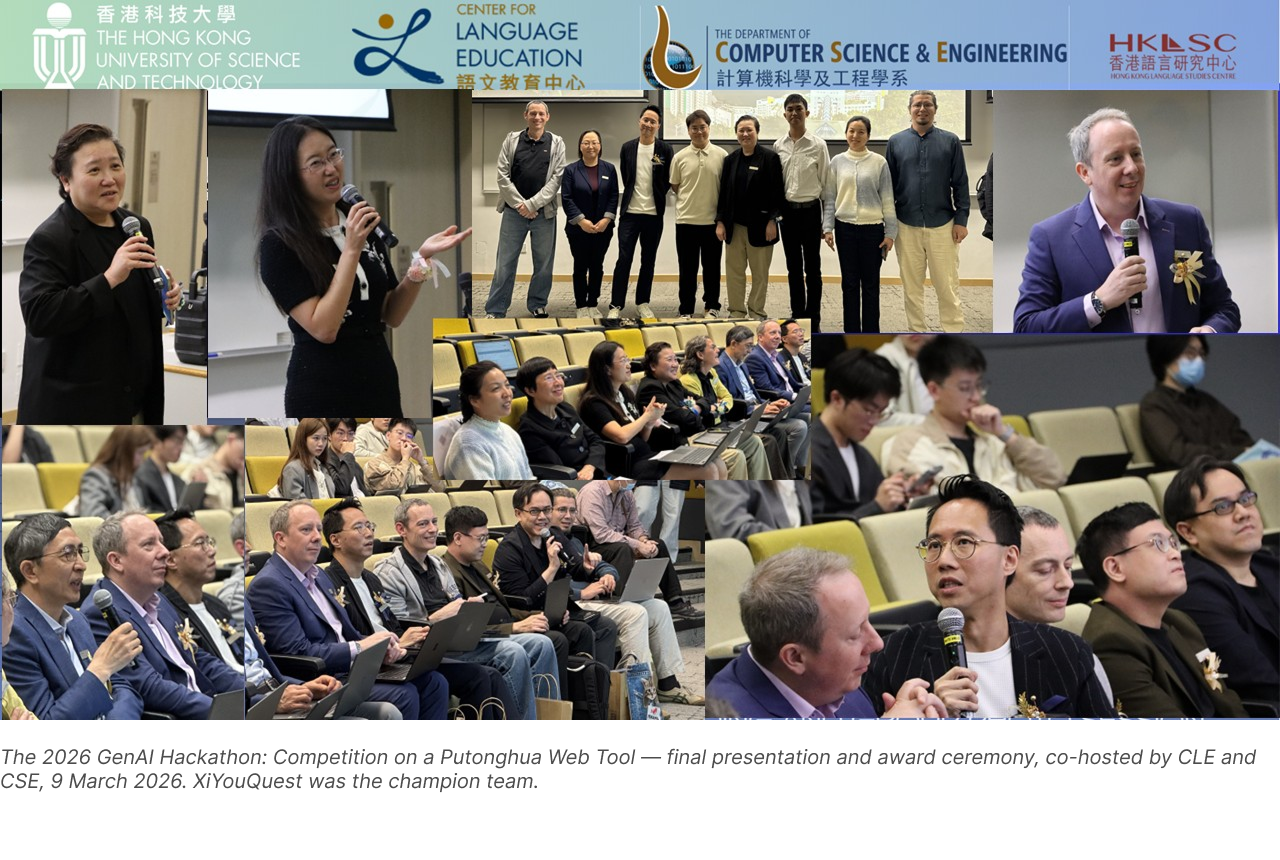
Together, these tools and hackathons demonstrate students as co-creators, shaping how AI supports communication learning and expanding CLE's innovation ecosystem.
Funded Projects & Grants
CLE's Human–AI Orchestration initiatives are supported by HK$34+M in HKUST-contributed funded projects, advancing AI-mediated speaking, writing, experiential engagement, assessment, and student innovation.
• 9 funded projects within CLE and across HKUST and other institutions
• 2 hackathons supporting student innovation and experimentation
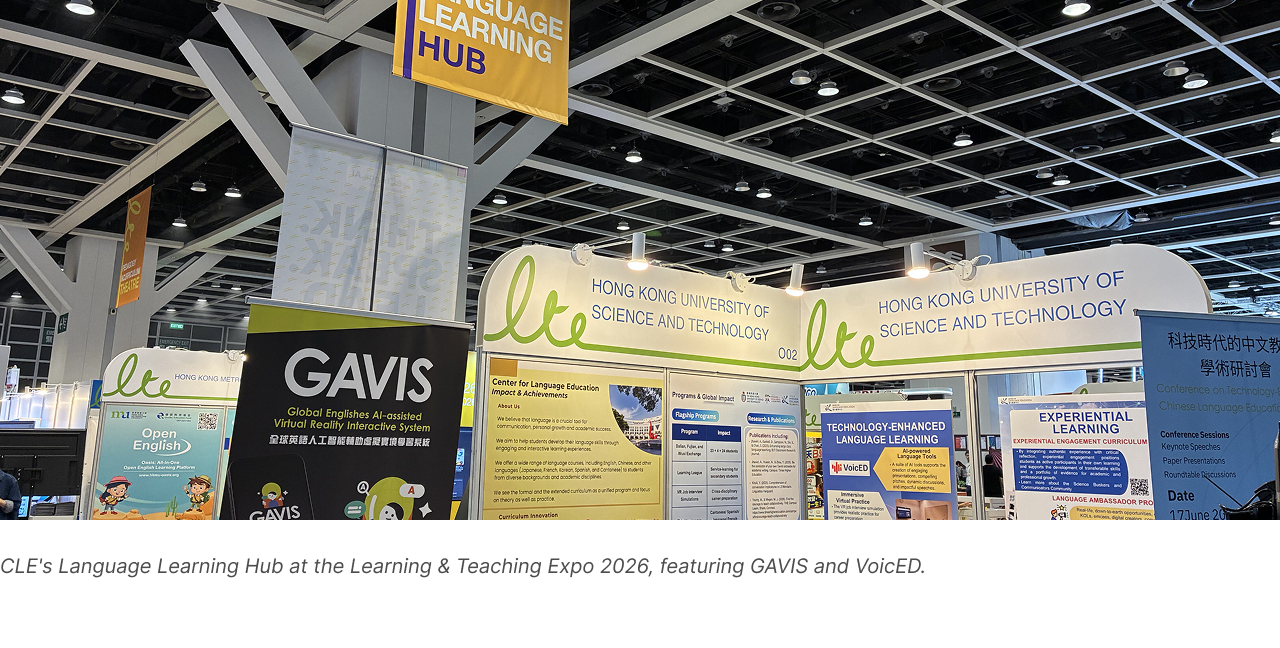
AI-assisted Virtual Reality English Speaking Programme for Secondary Students (GAVIS)
HK$30.4M — QEF
A project building GAVIS, a Global English AI-assisted Virtual Reality Interactive System to enhance speaking for secondary school students.
VoicED: The Oral Communication Platform for Academic, Social & Professional Success
HK$1.2M (HKUST) of HK$1.35M total — TDLEG-IICA
A cross-institutional oral communication platform — live events, AI-supported speaking practice, and educator exchange — built by HKUST, PolyU, HKBU, HKU, and CityU.
RubriX: A Multi-Agent GenAI Framework for Democratising Rubric Design and Assessment Practice
HK$1.06M — Large TLIP
A human-in-the-loop GenAI system for co-creating rubrics, calibrating them against real examples, and guiding reflection on assessment criteria — combining pedagogical, analytic, retrieval, and ethical AI functions.
Digital Literacy Hub: Enhancing Digital Communication, Experiential Learning and Authentic Assessment
HK$187K — TLIP
A dedicated space within CLE where students create, refine, and publish multimodal digital work — memes, promotional reels, podcasts, vlogs — as authentic, process-based assessment in LANG1405 and LANG2067. Trains student consultants and curates a growing repository of artefacts and exemplars for wider educational use.
Critical Reading and Writing Skills with GenAI MOOC Course
HK$220K — TLIP
A five-week MOOC on critical reading and writing in the age of GenAI — interactive learning, real-world examples, and guided use of GenAI tools to strengthen critical thinking, argument evaluation, bias detection, and responsible written communication.
Analyzing Self-Assessment with Artificial Intelligence
HK$599K — JC AI
Investigates how generative AI can support self-assessment and self-regulated learning — student experience, learning outcomes, metacognition, knowledge acquisition, and the design principles for effective, responsible human-AI interaction in education.
Rising to the Challenge of GenAI: Redesigning English and Chinese Undergraduate Writing Curricula by Embracing GenAI
HK$249,470 — EDGE AI
Addresses the impact of GenAI on undergraduate writing curricula and conventional assessment. Develops an assessment design module, guidance on emerging competencies, and a sample GenAI literacy module to support more valid, student-centred writing assessment in English and Chinese courses.
From Users to Builders: Teacher–Student–AI Co-Creation of Agentic AI Tools across Universities
HK$300K (HKUST) of HK$1.2M total — FITE-IICA
A collaborative initiative enabling students and teachers to co-design agentic AI tools for language learning. The project explores how learners move from users of AI to builders of AI-mediated learning experiences — shaping tools, interfaces, and workflows that support communication learning. It advances CLE's principle of Students as co-creators and contributes to emerging research on human–AI co-development in education.
AI Feedback and Grading for Tertiary Level Language Subjects
HK$300K (HKUST) of HK$1.75M total — TDLEG-IICA
A cross-institutional project — HKUST, HKPolyU, HKBU, HKU — exploring responsible AI-supported feedback and grading in language education. Redesigns writing tasks, develops AI-friendly rubrics, and evaluates AI-generated feedback alongside human judgement.
Scholarship & Research Excellence
All research outputs listed below are recorded on the HKUST Research Portal (PURE) and represent CLE's expanding academic leadership in Human–AI Orchestration & Agentic Language Education.
Human–AI Orchestrated Assessment & Feedback
Scholarly outputs shaping transparent, rigorous, human-centred assessment.
◦ A comparative analysis of AI grading tools: Efficiency, Pedagogy, and Human-in-the-Loop
◦ Towards transparent writing assessment: A human–AI orchestrated analysis of student writing
◦ Teacher Perception of GenAI as an Assessment Aid
◦ Rising to the Challenge of GenAI: Redesigning English and Chinese UG Writing Assessments by Embracing AI
◦ Assessing the Potential Challenges of Paid LLMs and Inequities in Language Classrooms: Assessments and Academic Integrity in Higher Education
◦ Comparing Feedback Quality: ChatGPT vs. Human Teachers in Developing Advanced Writing Skills
GenAI-Integrated Pedagogy & Curriculum Innovation
Scholarly outputs on AI-embedded instruction, literacy, curriculum redesign, and task design.
◦ Transforming Academic English Pedagogy: GenAI-integrated Tasks, AI Literacy, and the Psychology of Student Engagement
◦ Enhancing academic English instruction through pedagogically integrated GenAI: Effects on students' AI literacy and engagement
◦ Reimagining Curriculum Design: Empowering High-Order Thinking Through Gen AI Integration in Chinese Communication Education
◦ AI-embedded instruction to promote writer agency through scaffolded critical and creative decision-making
◦ Seven principles for effectively partnering with Generative AI for teaching and learning
◦ Mapping EAP/ESP pedagogy in the age of GenAI: Conceptualizing the use of GenAI for undergraduate writing development (a HK case study)
Learner Agency, Motivation & Human Capability
Scholarly outputs on learner identity, motivation, agency, metacognition, and reflective practice.
◦ Student knowledge, perceptions and use of Generative Artificial Intelligence (Gen AI) tools in language learning: Implications for learner agency
◦ AI and the other LLM, Language Learning Motivation: Motivational conflicts experienced by tertiary EMI students
◦ GenAI and research postgraduate student perceptions of authorship
◦ Reversing the Portfolio Pedagogy to Facilitate Style Transition in Academic Communication - the Scaffolded and AI-excluded Reflective Practice
Language and Communication — Writing, Speaking in an AI Era
Scholarly outputs on writing development, linguistic features, rhetorical choices, spoken communication, and GenAI's impact on language learning and use.
Writing, Rhetoric & Academic Communication
◦ Flexibility versus Formulaicity: Comparing Phrasal Verb Use between Human-written and AI-generated Academic Essays
◦ Be the conductor of your own GenAI orchestra for academic writing
◦ GenAI for writing development: leverage strength and circumvent weakness of current technology in pedagogical choices
◦ Mapping EAP/ESP pedagogy in the age of GenAI: Conceptualizing the use of GenAI for undergraduate writing development (a HK case study)
◦ Embracing Global Englishes in Language Education: Leveraging ChatGPT for Linguistic Diversity
◦ Text-Generative AI in Language Learning: Assessing its Impact and Advantages over Corpus-based Approaches
Speaking, Oral Communication & Workplace Interaction
◦ AI as a Communication Coach in the Workplace: Exploring the Potential of GenAI to Emulate Human Speech Acts
◦ How Technology Enhances PSC Testing: PSC 30th Anniversary in 2026
◦ Improving the accuracy and contextual understanding of chatbots in Japanese language education (日本語教育におけるチャットボットの正確性と文脈理解の向上)
◦ Evaluating the Use of a Chatbot in an Elementary Japanese Course: Benefits, Challenges, and Student Feedback
Community & Sector Engagement
• 5 cross-institutional partnerships shaping shared standards for AI in language education
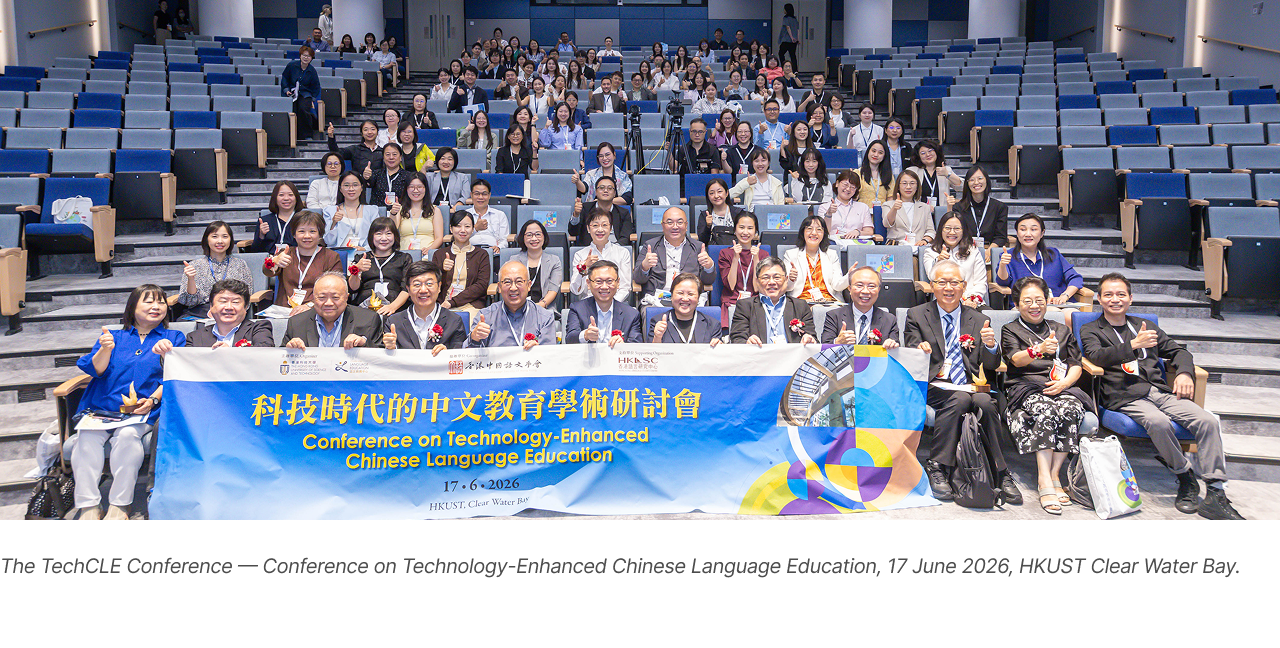
• 100+ participants with 73 paper presentations at the TechCLE Conference
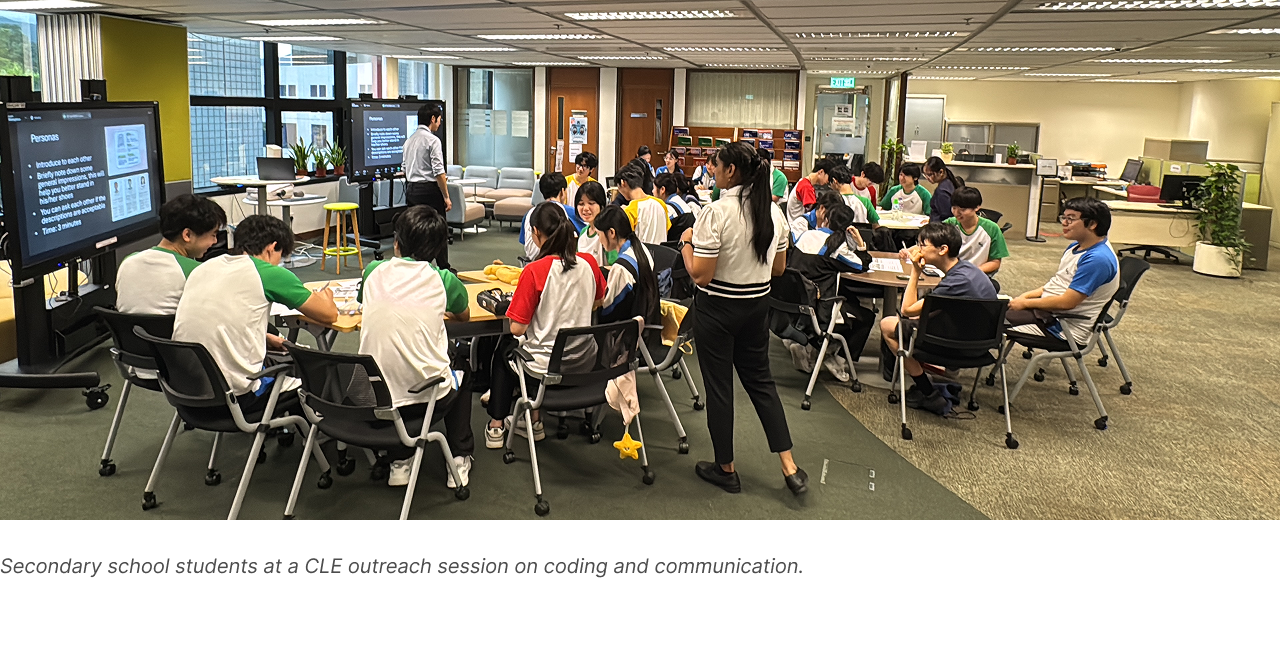
• A programme on coding and communication for secondary schools
Our AI Journey
- CLE responds quickly to the emergence of ChatGPT, with faculty exploring implications for writing, speaking, feedback, and academic integrity.
- CLE aligns with the University's GenAI Policy and introduces AI-use declarations across all LANG courses; by Fall, all students receive course-specific guidelines and complete a CLE GenAI literacy module.
- AI becomes a defined strand of CLE scholarship as an EDGE-AI funded project begins redesigning English and Chinese writing curricula and assessment around AI literacy, authentic assessment, and AI-supported feedback.
- Faculty and students share early practices through posters, talks, and workshops, exploring chatbots, writing pedagogy, prompting, feedback, academic integrity, assessment redesign, and AI literacy.
- AI expectations become embedded in quality assurance and learning platforms, strengthening consistency across courses and curricula.
- CLE launches a professional development series on AI use and begins the AI Resilience Project, auditing all LANG courses for AI-resilient design. Courses are revised and strengthened based on audit findings.
- CLE's portfolio of funded AI projects and grants expands, including the cross-institutional VoicED platform, RubriX, and more.
- CLE hosts its inaugural TechCLE Conference.
- CLE demonstrates AI-enhanced communication learning at the Learning & Teaching Expo — VR speaking practice, microlearning stations, and workshops.
- Four AI language and communication apps are built by students, for students, strengthening student agency and innovation with faculty mentorship.
- The Human–AI Orchestration Cycle (HAOC) framework is introduced.
- The Human–AI Orchestrated Grading & Feedback Project begins, exploring AI-assisted evaluation under human-in-the-loop review.
- CLE will launch five new HAIC courses, expanding Human–AI Orchestration across the curriculum.
- CLE plans new partnerships with universities to advance collaboration and innovation in language education ecosystems.
- CLE will continue developing AI-supported learning tools and agents, redefining assessment practices, exploring the Human–AI Orchestration and agentic language teaching and learning in CLE courses, and expanding experiential engagement initiatives.
- CLE aims to contribute to sector-wide leadership, sharing models, practices, and research that help institutions navigate and shape teaching and learning in AI in language education.